The TO CARE MED project has released a new Stakeholder Engagement and Cooperation Guidance, offering Mediterranean destinations a practical roadmap to involve local actors in shaping more sustainable tourism models.
As many coastal areas face growing pressure from over-tourism, the guidance helps partners adopt the Tourism Carrying Capacity Limit (TCCL) tool and embed it into local governance. The document outlines a structured six-step process to identify key stakeholders, activate participation, and co-create solutions that respect environmental and social limits.
A central feature of the guidance is the creation of Destination Working Groups (DWGs)—multi-sector teams bringing together public authorities, tourism operators, environmental groups, researchers, and community representatives. These groups collaborate through workshops, consultations, and data-collection sessions to produce evidence-based action plans.
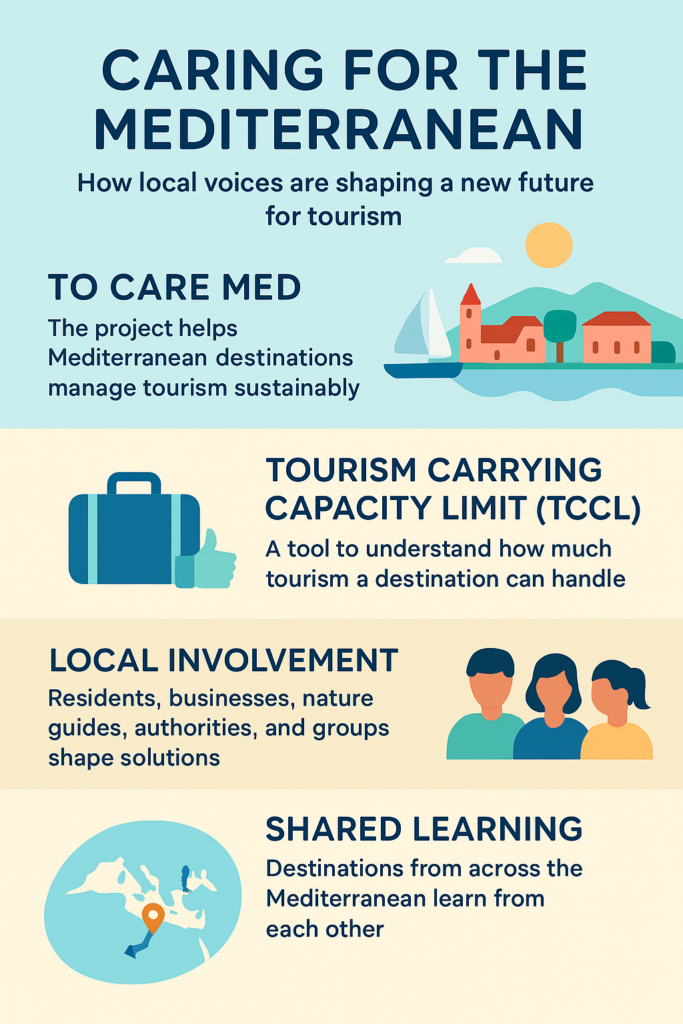
The guidance also highlights TO CARE MED’s strong transnational cooperation dimension, including peer learning, thematic workshops, and study visits that enable partners across the Mediterranean to share experiences and refine methodologies.
To ensure long-term impact, the document introduces two formal cooperation tools:
– Local Memorandums of Understanding, securing ongoing collaboration among DWG members;
– A Transnational Declaration of Commitment, uniting partners around shared principles for sustainable ecotourism governance.
By providing this framework, TO CARE MED supports destinations in managing tourism within ecological and social limits, fostering resilient, community-driven approaches for the future of Mediterranean ecotourism.
Download the guideline
Marco Buemi
Research Fellowship – Ca’ Foscari University
Peer Review: Nicola Camatti and Raffaella Lioce (Ca’ Foscari University of Venice)